
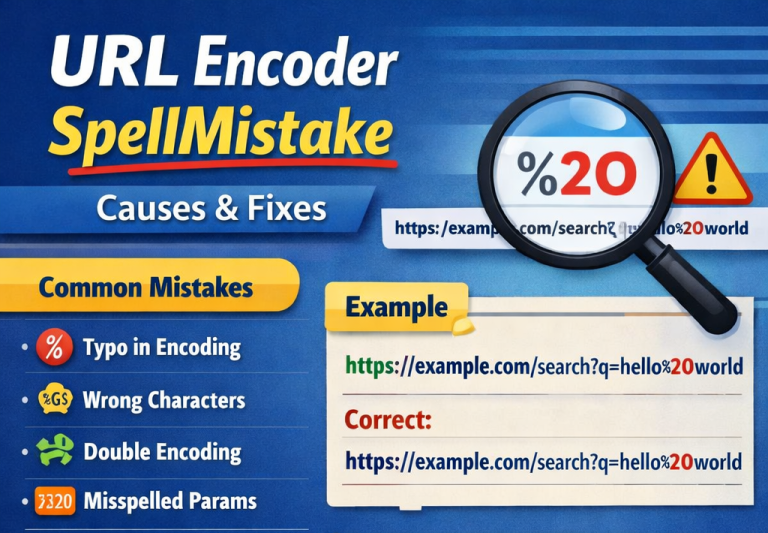
URL Encoder Spellmistake: Causes & Fixes Explained
In the vast world of the internet, every character in a URL matters. A simple typo or encoding error can lead to broken links, failed requests, or even lost traffic. One such nuance that often confuses web developers, content creators, and even casual users is the phenomenon known as URL encoder spellmistake. While it might sound technical, understanding it can save you time, frustration, and even website credibility. This article dives deep into the concept, how it happens, and what practical solutions exist to prevent or correct it.
What is a URL Encoder Spellmistake?
At its core, a URL encoder spellmistake occurs when special characters or spaces in a web address are incorrectly encoded or mistyped. URLs, or Uniform Resource Locators, are the addresses we use to access websites. However, not all characters are allowed in URLs. For example, spaces, certain symbols, and non-Latin characters need encoding to ensure that browsers interpret the URL correctly.
A typical example:
https://example.com/my page.html
The space in my page.html should be encoded as %20, resulting in:
https://example.com/my%20page.html
If this encoding is done incorrectly, or a user mistypes it (like writing %2O with a capital letter “O” instead of zero), that’s a URL encoder spellmistake. Such errors can lead to 404 pages, server errors, or misrouted traffic.
How URL Encoder Spellmistakes Happen
There are several common scenarios where these errors creep in:
- Manual Typing Errors – Humans make mistakes. Forgetting to encode special characters or using the wrong symbol is a frequent cause.
- Copy-Paste Errors – Copying URLs from documents or spreadsheets sometimes introduces hidden characters that break the link.
- Automated Encoding Bugs – Some web applications or scripts incorrectly encode characters, introducing errors silently.
- Browser Compatibility – Not all browsers interpret certain encoded characters the same way, leading to inconsistent behavior.
From personal experience, I once spent hours troubleshooting a broken internal link on a website only to realize the %2B sign was mistyped as %2b. That tiny inconsistency caused multiple internal pages to fail loading, costing valuable time and frustrating team members.
Real-World Scenario: Impact on E-Commerce
Imagine you run an e-commerce store. A URL pointing to a product page looks like this:
https://mystore.com/products/summer-sale?item=red+shirt
The plus sign (+) represents a space, so browsers usually handle it well. But if a URL encoder spellmistake occurs—say the plus is wrongly encoded as %2O (letter “O”)—your potential customer might see a “Page Not Found” error.
Even minor encoding mistakes like this can lead to:
- Lost sales
- Poor user experience
- Decreased trust in your website
Correctly encoding URLs ensures smooth navigation, higher conversion rates, and consistent analytics tracking.
URL Encoder Spellmistake vs. Standard URL Encoding
Understanding the difference between a genuine encoding process and a spellmistake is crucial. Here’s a simple comparison:
| Aspect | Standard URL Encoding | URL Encoder Spellmistake |
|---|---|---|
| Purpose | Converts unsafe characters to safe sequences | Mistyped or incorrect sequences |
| Example | %20, + → %2B | %2O (wrong case) |
| Browser Behavior | Interpreted correctly, page loads | May cause errors or 404 pages |
| User Impact | Seamless navigation | Broken links, poor UX |
| Common Cause | Correct usage in HTML, JavaScript, APIs | Human error, buggy scripts, copy-paste mistakes |
This table highlights why attention to detail is critical when encoding URLs. One wrong character can compromise an otherwise flawless web experience.
Tools to Detect and Fix URL Encoder Spellmistakes
Fortunately, several tools and best practices help prevent these errors:
- Online URL Encoders/Decoders – Websites like allow you to check and correct URLs before deployment.
- Browser Developer Tools – Most modern browsers can help detect broken links caused by encoding issues.
- Automated Testing Scripts – QA teams often run automated scripts to verify URLs, ensuring proper encoding.
- CMS Plugins – If you use content management systems, some plugins automatically encode special characters correctly.
Regularly checking URLs before publishing ensures that URL encoder spellmistakes don’t disrupt the user journey.
Tips to Avoid URL Encoder Spellmistakes
- Always Use Proper Encoding Functions – Programming languages like JavaScript, Python, and PHP have built-in functions to encode URLs safely.
- Avoid Spaces and Special Characters – Use hyphens or underscores for readability and SEO.
- Test Every Link – Even internal links can break if encoding is incorrect.
- Educate Your Team – Content writers and developers should understand the impact of URL encoding errors.
A disciplined approach not only prevents broken links but also improves SEO and user experience.
Read More: Ziimp .com Tech Review & Complete Guide 2026
Conclusion
A URL encoder spellmistake might seem minor, but its effects can ripple across a website, affecting traffic, sales, and user trust. By understanding what it is, how it happens, and employing proper tools and practices, you can safeguard your website from broken links and server errors. Consistently checking your URLs, educating your team, and using automated tools is the best strategy to ensure a smooth, professional web experience.
FAQs
Q1: Can a URL encoder spellmistake affect SEO?
Yes, broken URLs from encoding errors can reduce crawl efficiency, affect rankings, and lead to lost traffic.
Q2: How can I quickly detect encoding mistakes?
Use online URL encoder/decoder tools or browser developer tools to spot and fix incorrect sequences.
Q3: Are URL encoder spellmistakes common in large websites?
Yes, especially when content is managed by multiple teams or automated scripts are involved.
Q4: Can search engines handle encoding mistakes automatically?
Some mistakes may still render pages, but critical errors often result in 404s, negatively impacting SEO.
Q5: What’s the best way to prevent URL encoding mistakes?
Use built-in programming functions, avoid special characters where possible, and routinely test links.





One Comment