
Denver Broncos vs Chargers Match Player Stats: Comprehensive Breakdown of 2025 Head-to-Head Performance
The Denver Broncos vs Chargers match player stats from Week 3 of the 2025 NFL season reveal a tightly contested divisional showdown where individual performances drove key turning points. This article provides a holistic breakdown of every major player statistic, how each offensive and defensive unit contributed, and why certain players stood out. It is designed to give readers comprehensive insights into both teams’ player outputs, comparing strengths, weaknesses, and the influence of each contributor on the final result.
| Category | Detail |
|---|---|
| Game | Denver Broncos at Los Angeles Chargers – Week 3, 2025 NFL Regular Season |
| Final Score | Chargers 23 – Broncos 20 |
| Location | SoFi Stadium, Inglewood, CA |
| Team Total Yards | Broncos 265 – Chargers 376 |
| Time of Possession | Broncos 23:40 – Chargers 36:20 |
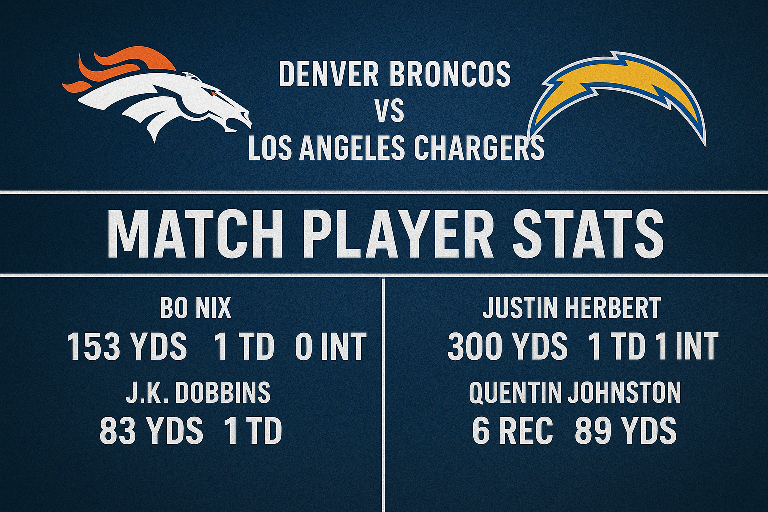
| Broncos Passing Leader | Bo Nix: 14/25, 153 Yds, 1 TD, 0 INT |
| Broncos Rushing Leader | J.K. Dobbins: 11 Rush, 83 Yds, 1 TD |
| Broncos Top Receiver | Courtland Sutton: 6 Rec, 118 Yds, 1 TD |
| Chargers Passing Leader | Justin Herbert: 28/47, 300 Yds, 1 TD, 1 INT |
| Chargers Rushing Leader | Omarion Hampton: 19 Rush, 70 Yds, 1 TD |
| Chargers Top Receiver | Quentin Johnston: 6 Rec, 89 Yds |
| Field Goals | Broncos: Wil Lutz 2/2; Chargers: Cameron Dicker 3/3 |
| Key Defensive Plays | Broncos TFL & sacks by Nik Bonitto; Chargers forcing turnovers |
| Game Deciding Play | 43-yard game-winning FG by Cameron Dicker |
Who Led the Quarterback Performances?
Denver Broncos – Bo Nix
Bo Nix led the Broncos’ passing attack with a stat line of 14 completions on 25 attempts for 153 passing yards and 1 touchdown without throwing an interception. Nix provided steady leadership and connected on key throws, including the deep ball to Courtland Sutton for a touchdown. Beyond pure passing, Nix also contributed on the ground with 33 rushing yards, adding flexibility and keeping defenses honest. His balanced efforts helped Denver stay competitive for most of the game.
Los Angeles Chargers – Justin Herbert
Justin Herbert served as the beating heart of the Chargers’ offense, completing 28 of 47 passes for 300 yards, 1 touchdown, and 1 interception. Herbert displayed his trademark arm strength and ability to extend plays, helping Los Angeles generate consistent chunk gains. Despite the interception, Herbert’s leadership on the final drive was critical, moving the Chargers into field goal range for the game-winning kick. His total yardage advantage was a decisive factor in the Chargers’ victory.
Which Running Backs Had the Biggest Impact?
J.K. Dobbins – Denver Broncos
J.K. Dobbins propelled the Broncos’ ground attack with 11 carries for 83 yards, averaging 7.5 yards per carry, and scoring 1 rushing touchdown. Dobbins showed burst, breakaway potential, and durability in his touches, offering Denver a consistent inside presence. His powerful 19-yard touchdown run showcased his ability to break tackles and spring long gains, giving Denver their first lead in the second half.
Omarion Hampton – Los Angeles Chargers
Omarion Hampton led the Chargers in the rushing game with 19 carries for 70 yards and 1 touchdown, playing a significant role in balancing Los Angeles’ offensive approach. His touchdown run early in the second quarter helped Chicago secure an early lead, and his contributions in the run game helped sustain long drives. Hampton also contributed in the passing game, adding versatility and keeping defenses guessing.
Who Were the Top Receivers in the Broncos vs Chargers Game?
Courtland Sutton – Denver Broncos
Courtland Sutton was a standout for Denver’s aerial attack, hauling in 6 receptions for 118 yards and 1 touchdown. His explosive deep touchdown catch highlighted Denver’s potential to generate big plays despite being outgained on offense overall. Sutton’s size, route discipline, and ability to make contested catches made him a go-to target throughout the matchup, consistently picking up critical yardage.
Quentin Johnston – Los Angeles Chargers
Quentin Johnston was Los Angeles’ most productive receiver with 6 catches for 89 yards, showing his capacity as a reliable secondary target in the passing offense. Johnston’s smooth route running and explosive speed helped stretch the field, creating separation and providing Herbert with dependable options whenever needed. His performance helped sustain offensive momentum, especially in key third-down situations.
How Did Kicking and Special Teams Influence the Game?
Broncos Kicker – Wil Lutz
Wil Lutz contributed two perfect field goals for Denver, connecting from 42 and 26 yards, adding crucial points that kept the Broncos within striking distance. His consistency under pressure helped Denver build a temporary lead late in the third quarter and extended their margin early in the fourth. Lutz’s accurate kicking provided reliable scoring opportunities when drives stalled near field goal range.
Chargers Kicker – Cameron Dicker
Cameron Dicker was instrumental in the final outcome, making three field goals in the matchup, including the 43-yard game-winning kick as time expired. Dicker’s performance kept the Chargers consistently on the scoreboard and ultimately secured the win. His clutch kicking under pressure highlighted the importance of special teams execution in tight divisional games.
Who Made Key Defensive Plays?
Denver Broncos Defense
The Broncos defense played aggressively, delivering key tackles for loss and applying pressure that forced difficult down situations. Linebacker Nik Bonitto was particularly disruptive, recording multiple tackles for loss and providing consistent pressure against the Chargers’ offensive line. Denver’s secondary also recorded turnovers and tight coverage, which limited big plays at crucial points.
Los Angeles Chargers Defense
The Chargers defense forced turnovers and made timely stops, particularly when it mattered most late in the game. They limited Denver’s offense on third downs and prevented the Broncos from converting drives into touchdowns consistently. Solid tackling in run support and strong positioning in coverage helped Los Angeles control the tempo and field position throughout the matchup.
What Do the Head-to-Head Trends Suggest?
The Week 3 matchup was part of a longstanding AFC West rivalry. Both teams entered with contrasting momentum: the Chargers at a perfect start within the division and the Broncos seeking to regain footing. The performance of key players like Herbert, Sutton, Dobbins, and Johnston reflects how this storied rivalry tends to showcase elite talent on both sides.
Offensive production, time of possession, and critical late-game execution by Chargers quarterback Herbert and kicker Dicker ultimately pushed Los Angeles ahead. However, Denver’s balanced attack and big plays from Sutton and Dobbins showed that the Broncos remain competitive within the division.
Conclusion
The Denver Broncos vs Chargers match player stats illuminate how individual contributions shaped a closely contested Week 3 game in the 2025 NFL season. Justin Herbert’s passing performance, Courtland Sutton’s explosive receiving, J.K. Dobbins’ powerful rushing, and Cameron Dicker’s clutch kicking were key factors influencing the final outcome. This breakdown provides a complete view of player performance, highlighting not just numbers but context behind how the game unfolded from an individual perspective.
FAQs
Q1: Who threw the most passing yards in the Broncos vs Chargers game?
Justin Herbert led all quarterbacks with 300 passing yards, using a mix of deep throws and short passes to build drives.
Q2: Which player scored the deciding points?
Cameron Dicker kicked the game-winning 43-yard field goal as time expired, deciding the matchup.
Q3: Who was the Broncos’ top offensive performer?
Courtland Sutton was Denver’s top offensive contributor with 118 receiving yards and a touchdown, complemented by J.K. Dobbins’ rushing impact.
Q4: Did any defensive players stand out?
Disruptive play from Denver’s pass rush and Chargers’ coverage units impacted key possessions, setting up scoring opportunities.
Q5: How close was the game overall?
Very close – the final score was 23-20, decided in the final seconds, showcasing strong performances from both sides throughout the contest.


2 Comments